Welcome to my blog. Here you will find an irregular record of my haphazard progress through an eclectic mix of projects, games and other assorted wargames-related nonsense.


You came here looking for toast and tea? Pop in a couple of slices and put a brew on. This blog is best enjoyed with hot buttered toast and a mug of strong, hot tea*.


*Warning - may contain puns.


Saturday, 15 December 2018

Call of the (Cruel) Sea - Part I


I've long had an interest in naval wargaming and in particular the actions of fast attack craft and coastal actions in WWII. No surprise then that I have been watching news of Warlord Games Cruel Seas with keen interest. I've resisted so far, but the call of the sea is strong!

My one concession so far has been the purchase of the December issue of Wargame Illustrated, which came with a plastic sprue of either two 1/300 scale Vosper MTBs or a couple of Kreigsmarine S-Boats and a 6-page article on the forthcoming Cruel Seas game. I don't normally buy Wargames Illustrated, but I rationalised this purchase as being purely for research purposes (who am I kidding!).

Wargames Illustrated, Issue 374. 
I only buy it for the articles (yeah, right).

Whoever is in charge of marketing at Warlord and Wargames Illustrated certainly knows their business as judging from comments online, the magazines have been flying off the shelves and quite a few punters have missed out on getting copies. I was lucky and got in early. Soon after, single sprues from the magazine started appearing on eBay and attracting bids at silly prices.

Warlord Games Cruel Seas S-Boat sprue. 
A Type S-38 and a Type S-100, weapons and torpedoes.


The issue I picked up has the pair of S-Boats - and very nice models they are too. If I had one minor gripe it would be that the waterline hulls sit 'flat' in the water as though stationary, or at very slow speed. These are fast craft and I want my S-Boats and MTBs to look like they are surging forward, bows raised, not sitting becalmed. On smaller scale models this would not have been so noticeable, but at 1/300 scale I think it looks a bit odd, especially the Vospers which had a more bow-up stance at speed than their S-Boat opponents.

Schnellboot vor!

Models aside, I've avidly read and re-read the Wargames Illustrated article on the game, supplementing this with all the official promotion, on-line videos, chat and froth that a new and shiny game generates. I really want to like this game. I have a collection of half-a-dozen rule sets for WWII coastal actions, all with their individual merits, but none of which I have ever been entirely happy with. This got me thinking about exactly what I expect from a set of WWII coastal action rules and how well my existing rules collection measures up to that. 

After much thought, I've narrowed this down to four key points:

1. Fast play

Actions were short, sharp affairs; strike hard, strike fast and get the hell out quick, so I'm looking for a set of rules with that feeling of pace. That means no written orders, no long lists of modifiers or numerous tables to refer to during play. Most game functions therefore need to be easily remembered and intuitive. A good example of a game that achieves this (though for aerial dogfights, not WWII coastal actions) is  Warlord Games Blood Red Skies. This manages to distil all the complexities of 3D aerial combat into a simple yet tactically subtle game while still retaining the feel of a WWII dogfight. Achieving something similar for coastal warfare MTB 'dogfights' would be the golden ideal.

2. Night fighting and illumination

Most WWII MTB coastal actions occurred at night, with all the attendant problems of sighting, identification and targeting. Vessels illuminated by searchlight, starshell or fires, (or silhouetted against sources of light) tended to attract gunfire. Crews could be blinded by both illumination of their own vessel, or the muzzle flash from continuous firing of their own weapons. These effects are not easy to represent on the game table, but any set of rules for WWII coastal actions needs to cover this important aspect.

3. Confusion

This is linked to point 2. Fast moving battles at night can quickly breed confusion. If someone fired tracer in your direction, a jumpy or trigger-happy crew tended to fire back. In the darkness it is not easy to distinguish whether your 'opponent' is actually friend or foe. There are plenty of contemporary accounts of friendly fire and occasions when groups of friendly vessels continued to exchange fire in ignorance, or pour tracer at 'phantom' targets long after the real enemy had left the battle area. Keeping station and maintaining situational awareness in the heat of battle was not easy. Losses due to damage caused by accidental high speed collisions with friendly vessels (and the enemy) were also not uncommon.

4. Doctrine and Morale

It might seem odd to lump these two concepts together, but what I'm really getting at here is crew behaviour. Are your forces aggressive or defensive? How much damage and loss is acceptable? At what point do you drop smoke and attempt to disengage? Coastal forces crews generally fought hard, but they were not suicidal. Aggression was always tempered by the need to preserve precious boats and crews. That means no games where players slog it out to the last boat. Rescue of friendly crews from stricken vessels should also be a requirement - and it wasn't unusual to rescue enemy crew too. How often do you see that in a WWII coastal forces game?

In Parts II and III, I'll take a look at my collection of WWII coastal actions rules and see how each of them measures up to these four key points.

Wednesday, 12 December 2018

Mythic Battles Pantheon - Athena vs Hades


Athena? Remember her? Had her own poster shop back in the 80's. You know. The one with the New Man with baby and that Tennis Girl scratching her bum. Call that art? Look at her now though; proper kick-ass Greek Goddess and leader of mortals. That's more like it! Here she comes to sort out that Underworld upstart Hades...

Odysseus - "I have a cunning plan my goddess..." 

It has taken far longer than either of us anticipated, but Pete and I finally got to revisit Mythic Battles Pantheon for a rematch. This time Pete controlled Hades and the forces of the Underworld (Cerberus and a pack of Infernal Hounds), plus the hero Atalanta, pitched against my line-up of Athena, Odysseus, The Minotaur and a unit of Hoplites. The action took place in Mino's Labyrinth, which should have suited the Minotaur right down to the ground. Events would prove otherwise.

Hades' forces go on the offensive

During the long interval since our first games Pete and I had forgotten some of what we had learned. This meant play started a little slowly as we rechecked rules. As neither of us was familiar with our forces' talents and powers we were also a little unsure of the most appropriate tactics. 

Hades and Athena rush to collect the precious Omphalos.

Pete took the initiative in the first game, sending Cerberus bounding out to dominate the centre of the board and collect his first Omphalos token. He proved impossible to dislodge, despite the Minotaur's best efforts. There was much skirmishing around the edges as Atalanta and Athena made use of their ranged attacks, but Athena's forces were hampered by the blocking terrain of the Labyrinth and it was Hades who got to another Omphalos token first, sealing his victory.

Cerberus and the Minotaur go head-to-head-to-head-to-head!

Game two picked up the pace as both Pete and I began to get the hang of our respective forces' abilities. Athena gained extra activations for her units through her special abilities, but Hades realised that he could draw strength from destroyed units (even his own) to recover lost damage - and strode about the Labyrinth with impunity. Meanwhile, the Infernal Hounds got the better of the Hoplites. A mighty charge by the Minotaur that barrelled through Atalanta, Cerberus and Hades was not enough to save the day and Hades' forces emerged triumphant again. Two-nil to Pete!

Unleash the Infernal Hounds!

So much for Athena. Maybe she's not cut out to be a Greek Goddess after all. Back to retail for you girl. You should have stuck with the poster vibe.

Once again, Mythic Battles Pantheon delivered a couple of fun and engaging games. Neither side found it a walk-over and once we'd started to grasp the subtleties of our respective forces' unique abilities the tactical options made game play even better.

We'll no doubt return to Mythic Battles Pantheon again in the (not too distant) future.

Wednesday, 5 December 2018

Mythic Battles - The Overlord Compendium III


A copy of The Overlord III arrived in the post a short while ago. I'd been waiting for this since January when Monolith first hinted at it on their forum.

There's a very active Monolith fanbase which has been largely responsible for the production of two previous publications; Compendium I and II, which covered additional material for Monolith's Conan boardgame. Compendium III aimed to do the same for Mythic Battles Pantheon.

Now I have my copy, here are my thoughts.

Versions
The Overlord III compendium is produced in both French and English language versions. This review is of the English language version.

Format
The Overlord III is A4 soft-bound, saddle stitched (i.e. stapled) and runs to 44 pages including covers.

Presentation
Printing is in full colour throughout on good quality thick, glossy paper. The layout is clear and easy to read and enhanced by illustrations from the game. Its good to see that Monolith haven't skimped on quality. Overall, this is comparable to the printed material in the core game. Top marks for Monolith here.


Content
There are eight scenarios for Mythic Battles Pantheon; three standalone and five for a campaign based on the Odyssey. Whilst all the scenarios look fun and challenging to play, they are not new material and are already available as free downloads on Mythic Scenarios. It is disappointing that The Overlord III compendium does not contain any original scenarios, though some do appear in English for the first time. Players who only own the Mythic Battles core boxed game may also be disappointed to find that several of the scenarios require one or more of the game expansion sets.

Continuing the Mythic Battles theme, The Combo Pool is a two-page article on a number of force recruitment options designed to be mutually supportive and beneficial. Choosing the right combination can enhance the overall strength of your chosen force, so if you are looking for ways to do this The Combo Pool will set you in the right direction. Maybe there are shades of power gaming here, but I think the article is useful beyond that in highlighting a few of what must be hundreds of potential combinations to experiment with. As with the scenarios, the examples include forces from several expansion sets, so you will need more than the core boxed set to try these out.

Next up is a tutorial. 'The Rocks' details how to make a 3D terrain element for the Mythic Battles map  'Olympus Ruins'. The tutorial steps are easy to follow and well illustrated, though the finished piece isn't the most inspiring bit of terrain. I much prefer the look of the 3D printable version offered by Monolith  as a downloadable .STL file on their forum. However, lack of a 3D printer makes the 'home made' version an acceptable alternative.


Fan fiction is a mixed blessing. Sometimes it can be surprisingly good, sometimes mediocre and occasionally unadulterated rubbish. The short story 'Phobius' can best be described as falling in the 'mediocre' camp. There is nothing terribly bad about the story or the writing style, but nothing terribly good about it either. To be fair, it does suffer in places from being translated rather badly from French into English and it may be that in its original language it is a decent story better told. Personally, I would have been happier to see more scenarios, tutorials or articles on game strategy instead of fan fiction, but I understand Monolith are attempting to cater to all tastes. Perhaps the intention was to offer some inspiration to Mythic Battles RPG players, though that isn't stated.

Of more practical use is a painting guide for Talos and other fire elementals. This covers four pages, liberally illustrated with step-by-step photos. The text is fairly easy to follow, but is somewhat marred in places by poor translation from French to English. In fact there's whole paragraph of text that hasn't been translated at all; signs of sloppy proof reading and editing. The writer refers to his choice of colours at various points throughout the text, but it would have been helpful if these could have been presented as a list, either at the start or end of the article.


At this point, the compendium departs from the theme of Mythic Battles Pantheon and devotes five pages to a primer on Norse mythology. This is anticipates Monolith's next instalment of the Mythic battles line; Mythic Battles Ragnarok. It is an interesting read and probably helpful in 'setting the scene' for Ragnarok. I don't recall seeing something similar from Monolith for Greek mythology, but perhaps their thinking was that Norse myth is less well known and deserves a better introduction to players. I  should say at this point that I have no interest in investing in Mythic Battles Ragnarok when it is finally released (presumably via Kickstarter), so my preference would have been more material for Pantheon - but that is no fault of Monolith's.


The final article is a photo-essay on the sculpting of a 'Demon Nurse' for Monolith's new game; Claustrophobia 1643. Again, I would have preferred more Mythic Battles content, but found the article an interesting insight into the sculpting and design process. For example, I had not appreciated the forethought required when designing large, complicated sculpts to accommodate multi-part castings. In this case, the underlying metal armature had to be designed in such a way that when the sculpt is cut into parts, the armature does not get in the way whilst still supporting the sculpt.


The rear cover of the compendium is devoted to a profile of Jarl Jorund (or possibly Jorun - there is some confusion here as the title says the former whilst the accompanying recruitment card says the latter). This is a new unit for the forthcoming Mythic battles Ragnarok. There is a brief description of the unit in play, recruitment and bonuses, plus the aforementioned cut-out unit cards which you will need to copy unless you want to deface your copy of the compendium. I guess Monolith have included this as a 'teaser' for Mythic Battles Ragnarok, though you could experiment by recruiting this unit to your Mythic Battles Pantheon forces (but you will have to provide your own model). 

Value for money
At the time of writing, The Overlord III is available for 3 euros from French game retailer Philibert. For a 44-page, full colour soft-cover book this is a very reasonable price indeed. However, once you factor in postage rates it does look a little less of a bargain. For example, postage to the UK is quoted at 9.95 euros. To be fair to Monolith, they have previously come in for some flak from customers who ordered but failed to receive copies of earlier publications - so this time, orders are only sent by trackable, signed-for postage which of course increases postage costs. Philibert also don't skimp on packaging. My copy arrived in a  heavy-duty card wrapper which meant it reached me in perfect condition, but at a cost in postage compared to a flimsy envelope or plastic wrapper.

Pros & Cons
Pros:
Good quality
Well presented
Useful, playable material and tutorials for Mythic Battles Pantheon
Value for money (base price)

Cons:
No new scenarios
Some material is unusable without Mythic Battles Pantheon expansion sets.
Poor translation, editing and proofing
High postage costs

Conclusions
The Overlord III Compendium isn't all that I'd hoped for. There's no denying the physical quality of the product, but this is let down by issues with translation and spelling that could easily have been picked up by some decent proofing and editing. Okay, it's fan-made so it isn't a 'professional' publication, but it has Monolith's input and endorsement; it's an 'official' product and Monolith are using it as a vehicle to promote their existing and forthcoming games. In that sense, I would have expected better. 

As to content, I do feel a bit cheated by the fact that none of the scenarios are new. Since this is a paid for product, I would not expect it to contain material that is freely available elsewhere, albeit in download format only. The inclusion of four pages of fan fiction just feels like padding to me. It adds nothing to my understanding or enjoyment of Mythic Battles Pantheon (though I appreciate that others may enjoy it, or find it inspirational). 

Overall, this is a useful but flawed product. I'm glad I got it but wish it delivered more. Perhaps my expectations are unreasonable, given the bargain price of the compendium (postage not withstanding), but I can't help feeling this is a missed opportunity to deliver some original content - even if that meant a greater purchase price.

In conclusion, I have given The Overlord III Compendium a rating of 3/5 ✮✮✮✩✩


Sunday, 7 October 2018

Vexatious Vexilology

In my last post I posed a question about correct flags for my Russian Civil War Izhevsk Rifle Division, having drawn a blank on useful references.

I also posted my question on the Lead Adventure Forum where forum members Mark Plant (of the splendid Pygmy Wars website) and Cuprum (of Studio Siberia) both offered some excellent suggestions and advice. Cheers guys! This included a link to www.kolchakiya.ru. The site is all in Russian, but fairly easy to navigate with the assistance of Google Translate. Here I found a mine of useful information on the histories, uniforms and flags of Admiral Kolchak's White forces in Siberia, including the Izhevsk Rifle Division.

The site describes several banners of the Izhevsk Rifle Division, including two St. George banners. According to the accompanying text only one of these, the "Battle flag of Izhevsk Division", was actually presented to the unit - so this is the one I chose:

'Battle flag of Izhevsk Division'. (source: www.kolchakiya.ru)

'Battle flag of Izhevsk Division'. Photo from the archives of the Museum of Russian Culture in San Francisco. Published in the book Efimov AG Izhevtsy and Votkinsky. The fight against the Bolsheviks1918=1920. M., 2008 (source: www.kolchakiya.ru)

The flag is described as a rectangular panel, divided into two equal parts. The left-hand part is white with a diagonal cross of St. George ribbon. The dates 7/VIII 1918 and 9/IX 1919 in gold are placed in the upper and lower quadrants respectively. The right part is White-Red-Blue (the colours of the Russian flag) with the letters "Izh" in gold on the centre blue band.

Unfortunately, no dimensions are quoted so I resorted to making my version 'wargames scale', i.e. large enough to look good on the wargames table. Using the two pictures for reference, I tinkered around in Photoshop until I had something I was happy with. As there is no description of the reverse side of the flag, I simply used the same design for both sides. I did ponder a bit about the colour of the St. George ribbon. These are usually black and orange stripes, but those in the picture are more of a golden yellow. Even allowing for fading, I doubt the original colour was far from what can be seen in the photo. Perhaps orange cloth was hard to come by! Anyway, here's what I came up with: 


After printing out on plain white paper, I carefully cut out the flag and applied a liberal coat of PVA glue to the reverse. After allowing a few minutes for the glue to soak into the paper, I folded the two halves of the flag together, wrapping the centre portion around a steel rod for the banner pole. The PVA made the paper quite wet and easy to shape into the desired folds, but once dry the shape is set and quite strong; good enough for the rigours of the games table at least. All that remained was to 'present' the banner to its unit by adding it to the standard bearer. 


Ready for action!

Tuesday, 14 August 2018

Izhevsk Rifle Division

Here are the first completed units for my resurrected Russian Civil War project.


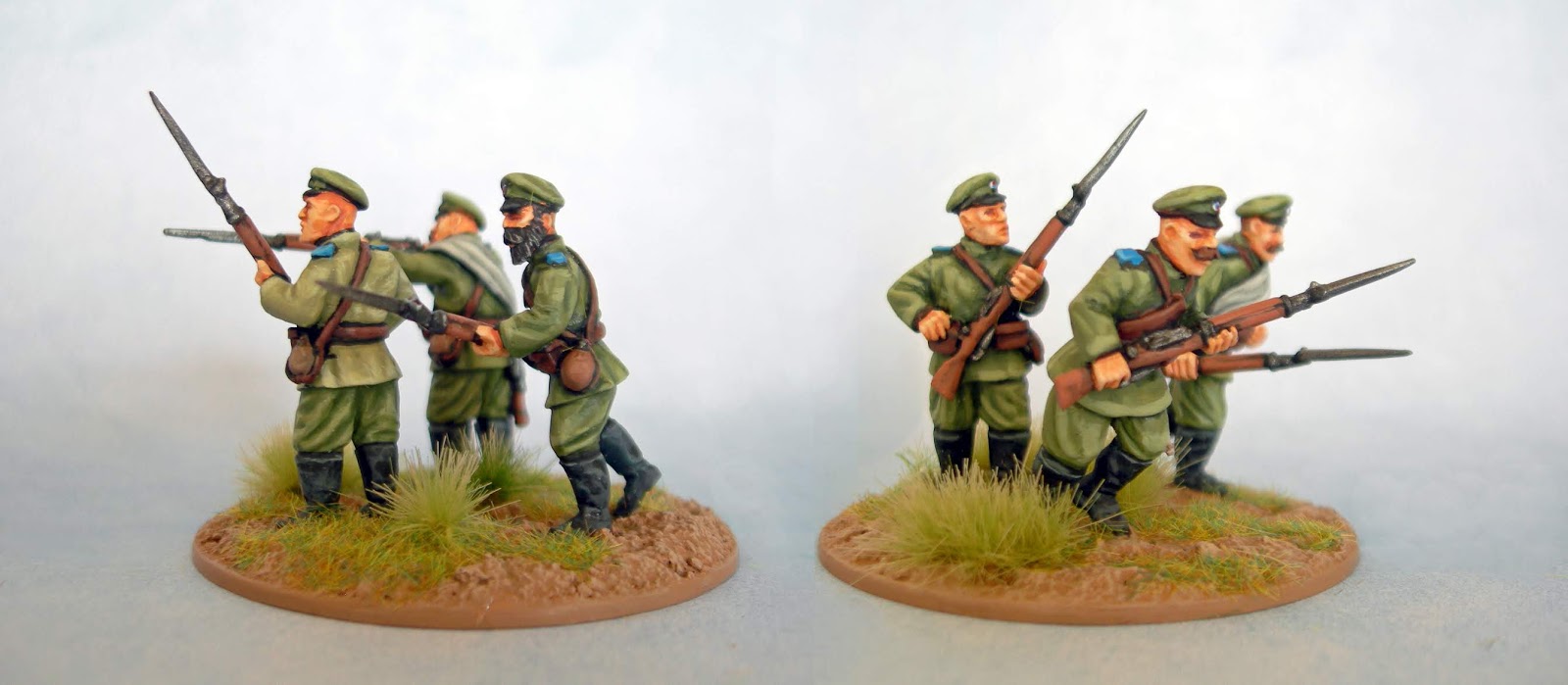
These guys are (loosely) based on troops of the Izhevsk Rifle Division that fought under Admiral Kolchak in Siberia and later as part of the Izhevsk-Votkinsk Brigade of the Far Eastern Army. They are probably a bit too 'clean' and rather more 'uniform' than their historical counterparts and their famous blue shoulder boards are a shade too bright, but I wanted something to make them 'pop' on the wargames table - so I hope I can be excused a bit of artistic licence.

Their banner caused me a bit of a headache as after much searching for references I have drawn a blank. I resorted to using a flag based on a Russian Imperial Regimental design. Flags like these were used by White forces in the RCW, which gave me the excuse to use it - and for no other reason than the blue colour matches well with the shoulder boards! If anyone reading here can point me in the direction of a more accurate flag, I'd be grateful for the advice.


The figures are all Musketeer (now Footsore) Miniatures WWI Russians, now available from Wee Wolf Miniatures, but they serve well as RCW Whites. They are bit slimmer than the Copplestone Castings miniatures that make up the majority of my RCW lead pile but I do like them, especially for the variety of poses which I think works well with my chosen basing style. Their only weakness is the bayonets. These look great, but being very slim and fragile I'm worried they are going to suffer some breakages, even with careful handling.


I mentioned in my previous post that I'll be using Red Actions! by The Perfect Captain for my RCW games. The basic element in Red Actions! is the platoon represented by around three figures, with up to six platoons making up a company. I chose to base my infantry figures in groups of three on 50mm round bases from Renedra, partly for ease of movement and also because I like the look of vignette style basing. Leader figures are individually based on 25mm round bases. In Red Actions! I'll probably use these figures to represent White Volunteers. 


So far, I've completed nine infantry bases which gives enough flexibility to field a couple of companies (one of 4 platoons and another of 5 platoons), or three understrength companies of 3 platoons each - though I'm going to need to paint up some more captains to lead them.


Monday, 16 July 2018

White Metal - Red Lead

Welcome to Mother Russia. In this episode, tea will be served from a samovar and caviar will replace butter on our toast...

Stop! Enough of this bourgeoise nonsense comrade! Tea? Caviar? Don't you know there's a civil war on?


My inspiration for a new gaming period can come from many sources. Sometimes its a film, a book, or a new range of figures. In the case of the Russian Civil War it was a set of rules; Red Actions! by The Perfect Captain. That was in 2006. At the time, I knew very little about the RCW, but soon found it has plenty to recommend itself to the wargamer. This is a conflict with WWI era weapons but with none of the trench-bound immobility of the Western Front. Here are troops of frankly dubious quality and even more dubious ideology engaged in sweeping actions from snow-bound Siberia to the Steppes of Central Asia. Here are units of every stripe from Reds and Whites, Nationalists, Makhnovist anarchists, Cossacks, Partisans, Interventionists and Czech legionaries; uniforms from the drab to the colourful; flags and slogans; armoured cars, biplanes, river gunboats, tanks and armoured trains. What's not to like!

When I started collecting miniatures suitable for the RCW the choice in 28mm was fairly limited, Copplestone Castings Back of Beyond range being the obvious choice. I amassed a nice little pile of lead that I have added to occasionally over the years. 


I hesitate to call this lead pile a project, since that would imply a degree of planning and forethought. I'm a bit more organised nowadays,  but back then my collection grew in quite a haphazard way. Some of it even got painted, but never sufficient to complete a single unit. That's something I aim to rectify now. 


My first step is to review and rationalise my collection of miniatures - and to get sufficient miniatures painted to fill the gaps in my part-completed units. That should give me some incentive to move things along. The longer-term aim is to complete sufficient figures to field around four infantry units, MG support, a unit of cavalry and a unit of artillery per side; around 150 figures. 

Okay, comrades. Forward!

Sunday, 3 June 2018

Saxon violence

Its not easy being a Thegn. Sure, you get some social status and privileges; maybe some land, better armour and equipment to strut around in and impress the pretty young mægdens. That sort of stuff. But its not all a big basket of rosy apples. Oh no indeed! First you have to suffer the attentions of some scalpel wielding modelling maniac intent on hacking away your fingers and wresting your spear from your grip. And now he's at it again, intent on pricking your pride with pin-sharp arrows. Oh the indignity!


Well, the Thegns are all painted and based, but I felt they needed a bit of battle damage. Not wishing to hack them about again, I thought the best way to represent this was by making them the target of a few arrows. But how to make them?

I wanted something wargames proof that would stand up to handling without snapping. That ruled out plastic rod or stretched sprue. Pins seemed the obvious choice, but I wanted the thinnest I could find to avoid my arrows looking more like scale javelins. After a bit of research, here's what I came up with; Prym super fine 0.4mm glass-headed pins made of flexible spring steel.


"These are really good" said the lady in my local haberdashers as I handed over my cash. No doubt she thought I was going to do a spot of hemming or quilting. I hadn't the heart to tell her I was going to chop them up to make tiny arrows.

It took a few attempts to get the fletchings right. These were made by cutting thin strips of 10 thou' (0.25mm) plasticard styrene sheet, which were then cut into shorter lengths and trimmed to shape. A thin layer of superglue was then applied to the shaft of the pin and each fletching carefully applied using fine tweezers. Once the glue had dried thoroughly, I ran another thin layer of glue along the seams of the fletchings for extra strength. To give each fletching a 'feathered' appearance, I drew a fresh scalpel blade across the edges several times to roughen them a bit.

Here's my first attempt. I found that the pins were long enough to cut in half to make two arrows. I wasn't entirely happy with the fletchings as they looked a bit too angular.


Here are a couple of later attempts, plus a broken arrow shaft, stuck in a blob of blu-tac to make them easier to handle for painting.


Once the arrows were painted, I chose some of the figures and drilled holes in their bases and shields; a task made easier by them being made of plastic rather than metal. After that, it was a simple matter of gluing the arrows in place...


…and here are the rest of the Thegns.


Well that concludes this little project. I'm pleased with the results and more so because it has got me back in to painting after a very long hiatus.

Okay, I'm off for toast and tea. See you next time!