Welcome to my blog. Here you will find an irregular record of my haphazard progress through an eclectic mix of projects, games and other assorted wargames-related nonsense.


You came here looking for toast and tea? Pop in a couple of slices and put a brew on. This blog is best enjoyed with hot buttered toast and a mug of strong, hot tea*.


*Warning - may contain puns.


Showing posts with label Cruel Seas. Show all posts

Monday, 3 May 2021

Bank Holiday Bits and Bobs

I've been stuck indoors today due to the typically sh*t Early May Bank Holiday weather - high winds and heavy rain. The upside is I've had a bit of a hobby day, in between drinking copious amounts of tea. Yes, there was toast too.

I don't often post uncompleted stuff on the blog, but it's been a while - and, well why not.

Currently on the painting desk are a bunch of Star Wars: Legion Imperial Stormtroopers. I love painting endless shades of pale grey and white. Not. They are great figures, just not very inspiring to paint, which is my way of excusing myself for my usually glacial painting progress. Don't tell their boss, or he'll find some "new ways to motivate" me! Still, I'm happy to have done some more work on them. One step nearer to completion.

"and over here we have... more unpainted miniatures!"

While I painted away, the 3D printer has been humming quietly in the background. Fresh off the build plate today; another terrain piece for Mythic Battles:Pantheon board game. It now joins the painting queue behind the Stormtroopers.

The ruination that is Mythic Battles.

I like some background listening while I'm painting - a chance to catch up on a backlog of podcasts. Queued up today and in no particular order were:

WSS Podcast - The Wargames Soldiers and Strategy crew. Always worth a listen.

The Grognard Files - The inimitable and eminently listenable Dirk the Dice. This one scratches my RPG itch, though it's a good few years since I last role played anything. (TSR's 1980's vintage 'Top Secret' revisited briefly in a fit of old school nostalgia in 2018). Sadly, it didn't last.

Lead Pursuit Podcast - Blood Red Skies (and other aviation wargaming topics). Usually something interesting, though I tend to 'tune out' when they get too much into 'the meta'. Great website too.

The Mad Axeman Podcast - I tend to skip through the chatter about about ADLG (Art De La Guerre) rules and competition games (not my thing at all), but there are usually some gems in amongst the general chatter, not least the now regular 'I'm sorry but I think you're an arse' feature. Check out Episode 77 if  (like me) you have never seen the attraction of wargaming the American Civil War.

I've also been busy making cards - specifically a Fortune deck for Pulp Alley. I've had a PDF copy of the 1st edition rules for a long time, but never had the opportunity to try them out. Cue an email from my cross-channel gaming buddy Ian, hatching another game idea and asking whether I had the rules. Well, we are going to need a Fortune deck, so I got busy with the printer, card and hobby knife. 

Pulp is on the cards

Over the past few weeks, Ian and I have been battling it out with Bolt Action via Skype using Ian's DAK and 8th Army forces. We have another game lined up this week, so I spent a bit of time re-reading the rules, the next scenario and pondering whether I'd made a good choice with my force selection. 


Speaking of Bolt Action, Warlord Games recently had a Spring Sale, so I took advantage and a couple of books came winging my way; Close Quarters for Cruel Seas and Air Strike! for Blood Red Skies. I've not done much with either game recently, but I like the simple pleasure of flicking through rule books - so I was able to indulge myself a bit today.

Light reading for a rainy day.


All-in-all, a pretty good day hobby-wise. 'Every cloud...' as they say.

Thursday, 31 January 2019

Strike Fast. Strike Hard! - A Review


There's no such thing as the 'perfect' set of rules. Everyone has their own ideas about how a particular period, genre or action should be represented. This can lead to some 'interesting' on-line discussions about the merits or otherwise of particular rules and what needs to be done to 'improve' them. Cruel Seas, the recently released WWII coastal warfare game by Warlord Games is no exception. You only have to check the various wargames fora, blogs, and social media to find an ever-growing list of house rules, suggested improvements and modifications intended to make the game more realistic and playable.

I am not immune to this compulsion to 'tinker' either. I'll admit to having my own list of house rules and modifications for Cruel Seas that better fit my idea of what WWII coastal warfare is all about. (If you want to read more about what I think should be represented, please have a read of my previous posts).

This got me thinking about the original and unadulterated rules for Cruel Seas; barely a couple of months since release and already bristling with an array of unofficial additions and changes. All these pet 'fixes' make perfect sense to experienced naval wargamers with knowledge of the subject, but the uninitiated might be forgiven for thinking that the game is somehow 'broken'. 

Along with this thought comes the realisation that I and wargamers like me were probably never near the top of Warlord's intended target audience for Cruel Seas. Just take a look at the box cover for the starter set, 'Strike Fast! Strike Hard!'  

The tell-tale sign. Not sure about those faux stains though.

See that logo in the bottom right-hand side? Yes, 'Bolt Action'. Could a large slice of Warlord's intended target audience be their legions of loyal Bolt Action fans? Okay - I know that's a huge generalisation, but you get the idea. This is a game that aims to appeal to the mass of wargamers who have not previously tried WWII naval games - and its going to do it with cool looking models, colourful rules and everything you need to get started, wrapped up in a neat starter set.

This rather long-winded intro' brings me to the point of this post.  Is Cruel Seas a good introduction to wargaming WWII coastal actions? To find out, I'm going to review the "All-Action" Starter box set - 'Strike Fast. Strike Hard!' with that question in mind.

The Box
The box art for Strike Fast. Strike Hard! really sets the scene. S-Boats and an MTB roar past each other at close range in a hail of automatic fire and tracer rounds while a merchant vessel explodes in the distance. The guy lobbing a grenade is a bit suspect, but the overall impression is speed, firepower and boat-on-boat combat, up close and personal. The choice of font style for the titles is perfect and the whole thing is very reminiscent of Commando Comics. Excellent! Just looking at the box art makes me want to play this game.

Strike Fast. Strike Hard! - channelling Commando Comics.

The Contents
The whole thing is satisfyingly weighty. Opening up the box confirms that it is packed with lots of goodies:
  • A4 softback Rule book
  • Six hard plastic sprues with parts to construct 6 x British Vosper MTBs, 4 x Kreigsmarine S-Boats, plus 16 x torpedo markers
  • Hard plastic sprue of plume markers
  • Three sheets of die cut, full-colour, double-sided punchboard game markers, counters and terrain
  • Ship data cards for the Vosper MTBs, S-Boats and a merchant tanker
  • Wake markers
  • Double-sided A0 size paper sea mat
  • Set of dice (d10 and d6)
  • Bag of cotton smoke / fire markers
  • Quick start painting guide
(Take a look at my previous post for some pictures of the box contents)

There's pretty much everything the first-time player needs to get started and get gaming straight out of the box. The only thing preventing this is the need to put the boat models together first. This should be no great chore as the models have a minimum of separate parts, but the rather basic assembly instructions on the Quick Start Painting Guide offer no favours to  newbies who may not easily identify the various weapons or know their correct placement.

I have seen some comments online about the dice and cotton markers being unnecessary as most wargamers will have these items already, but I think Warlord are to be commended for not skimping on these components and making this a true starter set for anyone getting into the hobby for the first time. Anyway, as every wargamer knows, you can never have too many dice!

Component Quality.
The hard plastic components (boat sprues, torpedo sprues and plume markers) are well moulded with a minor amount of flash that will require careful cleaning up around one or two of the smallest parts such as gun barrels.
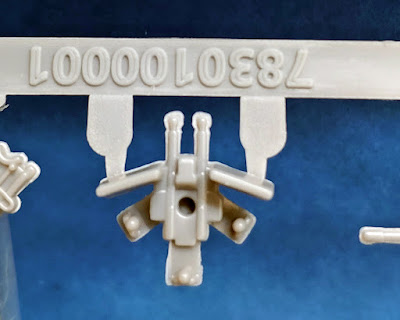
Muzzle flash was always a problem for coastal forces gunners :-)

Plume marker - a two-part component with 'plume' and clip-on base

The die-cut counters and terrain markers are good quality components printed on heavy card stock. There is also a set of die-cut cardboard 'rulers' marked in centimetres for measuring movement and turning. The rulers have  'jigsaw' connectors at each end so they can be clipped together to measure longer distances. Whilst this is a good idea in theory, I suspect that the connectors may become a weak spot with constant use. Most players will probably resort to using a standard tape measure for longer distances. A neat touch is the inclusion of the common modifiers for gunnery and torpedoes on the reverse of one ruler. Very handy. Its just a shame that useful game information wasn't included on the reverse of all the rulers.

Rulers - great for measuring, but not much of a jigsaw puzzle

The ship data cards are attractive but would probably have benefitted from being a little larger. The labelling for the weaponry on the deck diagrams is tiny and made harder to read by being white text in a very narrow font on a coloured background. Perhaps my eyesight isn't what it used to be.


The data cards use small 'clips' to track damage. These are functional, but not very robust. Of necessity, the card they are made of is thin so that they can flex to fit over the edges of the ship data cards. This also makes them rather flimsy and after repeated use they will tend to lose grip, or start to tear. Perhaps recognising this, Warlord have included plenty of clips in the starter set, but it would have been nice if they had produced a set of plastic clips. As a starter product they should be good for initial games, but I foresee players replacing the card clips with metal or plastic paperclips in the long term.

Damage tracker clips - flimsy but functional

If you are starting out in naval wargaming you will need something to represent the sea on the table top. Strike Fast. Strike Hard! has this covered with the inclusion of a sea mat, printed on a sheet of A0 size paper (841mm x 1189mm). This is double-sided, (blue or dark blue) so players can choose to represent actions in, say, the Pacific or North Atlantic. The whole sheet folds down to A4 size in order to fit in the starter box but does suffer from very noticeable fold lines as a result. It is just about the minimum playable area for games using only a few vessels, so fine to get you started for your first games. Being made of paper, its useable lifespan is probably limited but it is a perfectly serviceable and useful inclusion for a starter set.

The Rulebook
The softback rulebook is perfect bound, A4 format, 108 pages and full colour throughout. The binding on my copy is sound, with no tell-tale 'cracking' as the book is laid open. Only time and repeated use will reveal any issues  - well outside the scope of this review.


The book is well presented with a decent sized font, laid out in double column with clear headers and the occasional sidebar for additional information. It is also profusely illustrated with diagrams to explain game functions, but mostly with 'dioramas' of model ships and illustrations from various Osprey publications. It all looks very pretty and makes for an attractive publication, though much of it is really no more than 'padding'. Still, having lots of pretty pictures is de rigueur for a commercial ruleset these days. Ours is a very visual hobby and if it helps draw in new players and sells product then Warlord can hardly be blamed for making their rulebook as appealing as possible.


So much for looks. But what of the contents?

The rulebook has clearly been written with starting players in mind. In the Introduction it describes itself as "an entry point into naval gaming" and in addition to the rules there are sections on the history of MTBs, the theatres of war, navies of the major combatants, plus a bibliography of recommended further reading on the subject.

It would have been impossible for Warlord to cover these aspects in anything but the briefest terms, but there are some odd inclusions. For example  the "Channel Dash"  is mentioned twice, though MTB actions against capital ships seems well outside the scope of the rules.


Coverage of each nation's forces is uneven. It seems that the authors found plenty to say about Kriegsmarine and British forces, but struggled to match this for other nations. This has led to some unnecessary and rather prosaic 'padding', which has nothing of relevance to WWII small craft coastal actions. For example, we are treated to a list of the 1941 Soviet Navy battleship, cruiser and submarine strengths and a paragraph on the performance of the Soviet submarine forces. The section on Italy's Regia Marina contains similar information and elsewhere we learn that "The Mediterranean was the grave of many submarines on both sides".

I do think there is a missed opportunity here. New players  need something that will give them a sense of the unique nature of WWII coastal actions. Ideally, this would be a succinct overview of WWII coastal warfare explaining the role that MTBs and similar craft were developed for, the environment they operated in, how they were organised, their targets, their principal weaponry, the tactics employed and how these evolved throughout the war. The rulebook does provide some of this, but it is patchy in places and diluted by the inclusion of irrelevant information.

On a more positive note, players are encouraged to do some further reading on the subject and the rulebook assists this with a bibliography of suggested titles. For an introductory set of rules, it makes good sense to point new players in the direction of further information that will develop their interest and (with luck) their continued investment in the game.

Proofing and editing
Anyone who follows the wargames news will be aware of the backlash that erupted over the release of a 10-page set of Errata, hot on the heels of the game's release. As someone who received the starter set after the Errata were released I fully understand the disappointment and dismay expressed by many in similar circumstances as it really took the shine off the game. I'm not going to belabour the issue here, but as this post is specifically about the merits of Strike Fast. Strike Hard! as an introduction to WWII coastal wargaming I do want to make a few observations about the effect of quality control on this aspect.

Oops!

The first thing to say is that as a starter set, the game should be playable right out of the box. Did the Errata make the game unplayable? Well, no - but it did mean that players either had to print and paste the amendments into their brand new rulebook, or refer to a separate copy of the Errata during play. Not the greatest experience for new players (or old ones for that matter) and a very poor advertisement for the game.

Several mislabelled illustrations are further evidence of sloppy proofing. Those of us who know a Vosper from a Fairmile will spot these kind of mistakes easily. New players will not. Does that matter? It makes no difference to playability, but it does mean that players who are unfamiliar with the setting are likely to accept the incorrect information presented to them as 'fact'.  I think they deserve better.

The Rules
I've tried out a few games to test the rules, all of which have been enjoyable and quick to play. Being time-poor and notoriously slow, I haven't finished building and painting the models from the starter set. To curb my impatience I resorted to a short-cut and printed out some simple card counters, so please excuse the lack of 3D models in the accompanying photos. I'm sure you'll still get the general idea.

Scenario 2 - Torpedo Run. Tricky blighters those eels. Damned if I can spot them.

The basic rules cover just eight pages, including illustrations, diagrams and tables. They are followed by three introductory scenarios designed to get players started quickly. The game mechanics are quite straight forward. Activation of individual vessels is achieved by drawing dice from a bag. Movement rules are simple with just four speed rates (stationary to full) that also govern turning rates.  Gunnery is resolved by rolls to hit on a d10 with a small list of modifiers, then rolls to determine damage with handfuls of d6. Torpedoes are represented visually by counters moved on the tabletop.

This is perfect for new players and those who have not tried naval wargames before. The dice-draw activation introduces a random element and some tactical choices, especially as torpedo movement is tied to the 'owning' vessel's activation. Movement is quick to carry out and use of wake markers make it easy to keep track of each vessel's speed. Players get to roll plenty of dice and the handfuls of damage dice gives a satisfying sense of shredding chunks out of the opposition. Most importantly for an introductory game, it's fun!

In the galley of MTB 29, able seaman Pratt had accidentally started another chip-pan fire.

A further 15 pages of  Advanced rules covers aspects such as crew ratings, collisions, critical damage, equipment and mines. This is followed by a further five scenarios and it is here that the 'play out of the box' concept starts to break down. Most of the scenarios require a playing area larger than the sea mat provided and  specify vessels which are not included in the starter set. Warlord no doubt hope that new players will continue to invest in the game and buy their shiny new toys as they are released.

The Basic and Advanced rules are rounded out by sections on Terrain, More Weapons and some generic Aviation rules. Plenty to keep new players involved.

And then there are the submarines. It really feels like Warlord couldn't make up their mind about submarines. On the one hand, the book is peppered with references to them and they feature in at least four of the model dioramas that illustrate the book, with captions such as "The dreaded U-boat passes next to its latest victim" and "A silent killer inspects its burning prey". On top of all that, what did Warlord choose as the special 'free' miniature with pre-orders of the rules? Ah yes, Das Boot. A U-boat. Hmm.

On the other hand, Warlord tell us "We have deliberately left submarines out of these rules" yet in the same breath adding that they do feature in the game, but only as targets or objectives. What's going on here? It seems to me that Warlord are attempting to appease players hoping to field these 'silent killers', whilst simultaneously relegating submarines to the role of targets. So yes, you can have your u-boats, but it's not quite 'Das Boot'. Wolf-packs in sheep's clothing perhaps? Maybe it would have been a braver decision to have left submarines out of the rules completely and made them the subject of a supplement for those who want them. They don't have much place in a starter set about, as Warlord puts it, "swirling naval dogfights".

Sorry Warlord ;-)

Longevity
If the primary function of a starter rule set is to attract new players to the genre, then a secondary function must surely be to keep them. Judging by the fact that the initial release sold out in short order, Warlord are probably doing well at drawing in new players to naval wargaming. Only time will tell how successful they are at keeping them.

A weak point may be the lack of well known actions for players to recreate; the kind of thing that provides a hook for new players, generates an interest in the historical setting and fuels miniature purchases/collecting forces. Land-based WWII wargames fare much better in this respect.  For example there is no shortage of inspirational material on actions such as Stalingrad, the Battle of the Bulge, D-Day, Arnhem, etc. Just think how many times you've seen Pegasus Bridge cropping up at wargames shows. There's nothing really comparable in WWII coastal wargaming. The closest is probably the St. Nazaire Raid, but that's just one action and not at all representative of WWII coastal warfare in general.


So what's the remedy? Warlord have made a start by providing eight very varied scenarios within the rulebook. Sure, they are generic rather than specific actions, but that does mean they can be adapted to player's chosen theatres and forces without too much difficulty. What is really needed though is some sort of context in which to place individual games, such as series of linked scenarios or a mini-campaign. The rulebook does contain a brief section entitled 'Playing A Campaign' but  disappointingly, this is no more than a few ideas on random sea conditions, hidden deployment and a list of Special Abilities for Veteran crew. It's not really a framework for running a campaign at all.

I think Warlord would have done better to have ditched the 'padding' that I referred to earlier in this review and devoted that space to a proper campaign system, or a series of half-a-dozen linked scenarios that would give new players an idea of how to construct their own series. A positive side-effect of this would be that it encourages more historically realistic behaviour. Here is an incentive to preserve boats and precious crews, disengage before losses become unacceptable and attempt to rescue crew from stricken friendly vessels. Cruel Seas doesn't have any rules for morale (only a brief section on voluntarily surrendering) so this would go some way to introducing behaviours that replicate the reality of WWII coastal actions.

Value for money
At the time of writing, the Strike Fast. Strike Hard! starter set retails for £50.00 on Warlord's website, though there are better deals out there if you look for them. This is probably on a par with the cost of getting started in other new wargames periods or genres. When you consider the amount and quality of material provided in the box set, I do think this is very good value for money. Add to that the fact that everything needed to get playing is included in the box and you have a very attractive entry level game for players wanting to try out naval wargaming for the first time.

Pros & Cons
Pros:
Attractive presentation
Good quality components
Simple rules
Fun to play
Value for money
Has everything needed to get playing

Cons:
Poor proofing and editing
Unnecessary 'padding' with content of little or no relevance to the scale of operations being depicted.
Not all scenarios are playable 'out of the box'
No proper campaign system or examples of linked-scenarios


Conclusions
So, is Strike Fast. Strike Hard! a good introduction to wargaming WWII coastal actions? On balance I think that it is, though it is not without flaws.

We live in an age when many players want and expect to be able to buy into a new game with everything that is required provided in a single, neat 'official' package. Warlord clearly understand this and Strike Fast. Strike Hard! does a good job of delivering on these expectations with a product that has visual appeal, cool models, all the components required to get started and a simple but fun set of rules.

The rules are firmly towards the 'game' as opposed to simulation end of the spectrum, but for an introductory set that's no bad thing. On the downside they do seem to have been rather rushed into publication without sufficient playtesting and consequently have some odd quirks, such as tankers out-turning MTBs and torpedoes that can't sink a destroyer. Old hands at naval wargames will soon devise their own rules to correct these quirks, but for new players I really don't think this is such an issue. Having a game that gets toys on the table with minimum fuss and offers enough challenge and excitement to want more is what it is all about here.

Warlord also deserve some credit for attempting to provide some historical background information for players unfamiliar with the setting. Its a pity this is rather uneven in its coverage and that Warlord appear to be slightly confused at times about the level of game they are representing. It could have been better, but it is still good to see.

And finally...
One last thought. Remember that Bolt Action logo? Bolt Action has been going strong for about 6 years now, with more than 23,000 copies* of the 1st edition sold and is currently in its second edition. It began as a fun, simple game that was ideal for introducing new players to a historical setting, drawing many players from the Warhammer 40K community. Sounds familiar? Its really no accident that the Bolt Action logo appears on the box cover of Strike Fast. Strike Hard! and it is interesting to speculate on where the game may go if Warlord put enough backing and support behind it. Games representing WWII coastal actions have occupied a fairly small niche within the hobby and this is the first time they have really been given the kind of mainstream treatment that WWII land-based wargames enjoy. For this, Warlord Games are to be commended. If this introduces new players and generates an interest in the history of WWII coastal forces then that can only be a good thing for the hobby.


*Source - Osprey Publishing

Wednesday, 26 December 2018

Cruel Seas Christmas


Santa (or one of his elves) must read this blog. Look what I got for Christmas! 

Yes, the Cruel Seas Starter Box - Strike Fast. Strike Hard!


I've not had time to do more than open the box and check the contents (all present and correct), but I shall no doubt take a closer look during the Christmas break.


There has been a good deal of 'noise' recently about quality issues, pages of published errata and some critical comments about rules ambiguities and historical inaccuracies - but I'm trying not to let that spoil my enjoyment. The message that seems to be coming through so far is 'Flawed but Fun', so I'm very much looking forward to reading through the rules and also seeing how they match up the four key requirements for WWII coastal action rules that I covered in my previous posts.


Merry Christmas!

Sunday, 23 December 2018

Call of the (Cruel) Sea - Part III


This is the third and final part of my review of the WWII coastal warfare rule sets from my collection, with a particular emphasis on four key areas:

Fast Play
Night fighting & illumination
Confusion
Doctrine & Morale

In Part 1, I explained why I think these are the key aspects of WWII coastal warfare that I want to see represented in rules for these actions. 

I've covered three rule sets in Part II. Here, I look at the final pair of rules and also draw some conclusions about the general approach to rules writing for these conflicts.

So, on to the rules...

Attack With Torpedoes v2.0 by Dillon Browne (April 2003)


In his introduction, the author explains that there were two incentives that led to him write these rules. Firstly, in order to run a participation game at Salute 2003 and secondly, his feeling that the rules he had previously used produced games that were too slow.

The rules include a very brief introduction to Coastal Warfare, in which the author recognises the unique nature of battles fought by small, fast craft at night, including difficulties spotting and identifying targets, the effects of illumination - both to attract fire and to dazzle firers, and the possibility of friendly fire. Hmm, so far so good.

1. Fast Play

Given the author's stated intention to produce a set of fast play rules, it is a surprise to find that Movement is determined by players' written orders. In this respect they appear most like the Fast Attack rules I covered in Part II. But, there is a twist;  an optional rule penalises the last player to complete writing their orders by restricting their vessel's move to a straight line, with a single turn at the end of movement. This introduces a bit of pace and urgency to the game and encourages players to complete their orders quickly to avoid being last. Once orders are written, movement is simultaneous, which also speeds up play. The mechanics of the game are very simple, so play doesn't bog down cycling through numerous steps to move or fire. There are very few tables and the QRS containing all the basic game functions fits on a single side of A4. 

2. Night fighting & illumination

The rules contain a section specifically on illumination which includes daylight, fires, searchlights and starshells. This section also covers the effects of targets being silhouetted when in front of illuminated areas, searchlight beams or tracer fire. There are also rules for target priority, with illuminated targets being one of a number of situations that will draw fire (whether the players wish it, or not). The gunnery rules take account of the fact that illuminated targets are easier to hit, but continuous firing of one's own weapons at night will impose a penalty to hit due to the effects of muzzle flash.

3. Confusion

The gunnery rules include a specific test for friendly fire, so it is possible that you may end up targeting one of your own vessels instead of your intended target. The use of written orders increases the chance of accidental collision, with simultaneous movement being broken down to determine any probable accidents. There is a section on concealed movement, though the author gives their opinion that there is no single ideal for representing this and suggests players experiment with several options including use of an umpire, or dummy markers.

4. Doctrine & Morale

Attack With Torpedoes does not have any rules for the effects of morale. However,  a section on 'When to Abandon Ship' includes the requirement for the attacking force to attempt the rescue of friendly crew who are forced to abandon their vessel. The author suggests that abandoning friendly crews will count against their side's victory conditions and be bad for morale. Exactly how is not explained and it is left up to players to devise their own rules or scenario conditions to cover this.

Here's how I've rated Attack With Torpedoes for my 4 key areas:

1. Fast Play ✮✮✮✩✩
2. Night fighting & illumination ✮✮✮✮✮
3. Confusion ✮✮✮✩✩
4. Doctrine & Morale ✩✩✩✩


Patrol Torpedo v2.1 by Michael Pennock (2007)


This is the last of my WWII coastal warfare rules up for scrutiny. You know the drill by now, so without further ado...

1. Fast Play

Activation is determined by drawing chits from a bag or cup. Each time a chit is drawn, all vessels move, but the value of the chit determines which boats can issue orders to do things like change speed or course, fire or attempt repairs, etc. Turns are broken down into 5 phases with vessels moving part of their full move speed in each phase. This necessitates a full-page table of power settings and speed-per-phase values. As frequent reference to this table is required, this rather slows an otherwise slick activation and movement system. The gunnery procedure involves three steps with rolls being made by individual weapon; Targeting roll, Effectiveness roll and Damage. There's the obligatory table of modifiers, 15 in all. It works fine, but being multi-step it isn't particularly fast. Other than tables for Gunnery, there are very others in these rules. There's no QRS, but all the tables from within the rule book would easily fit on a single side of A4.

2. Night fighting & illumination

There are simple rules for illumination by starshell, flares, searchlight and fires, all of which affect visibility, spotting and gunnery. The area effects of illumination are considered, with vessels able to see into and out of illuminated areas, but not through them. Silhouetting of targets is not considered. The rules also give no consideration to target priority, regardless of whether a vessel is illuminated or not.

3. Confusion

In Patrol Torpedo there is no chance of misidentifying targets or confusing friendly vessels for the enemy. Phantom targets and friendly fire don't feature in this game. The activation system does introduce a degree of unpredictability as vessels always move each phase, but can't always issue orders to change course or speed. Accidental collisions are a therefore a distinct possibility.

4. Doctrine & Morale

Unique amongst the rules I have covered here, Patrol Torpedo introduces the concept of formations. The rules specify that vessels operating together should maintain one of several possible formations; line astern, line abreast, echelon, etc. Maintaining formation reduces initiative but allows all boats in the formation to match the lead boat's course and speed. Other than this, it is hard to discern what effect the author intended. There are no rules for morale that might break up a formation or encourage separated vessels to re-join, or to come to the rescue of stricken friendly vessels.

So, the ratings for Patrol Torpedo look like this:

1. Fast Play 2/5 ✮✮✩✩✩
2. Night fighting & illumination 2½/5 ✮✮✮✩✩
3. Confusion 2/5 ✮✮✩✩✩
4. Doctrine & Morale 1/5 ✩✩✩✩


CONCLUSIONS

Before I continue, I want to emphasise that the comments and scores given above and in Part II are not intended to rate the how 'good' the rules are, nor are they a competition to find which rule set is the 'best' (a very subjective term). Speaking from experience, all these rules sets are perfectly playable and capable of providing a fun and exciting game.

Instead, what I have attempted to do is measure how well I think each of these rules represents several key features of night-time WWII coastal actions. These key features are my based on my reading and research of the subject and my understanding of how these actions were conducted. The opinions expressed here are solely my own. So, with those thoughts foremost, what conclusions can be drawn from this exercise?

The first thing that struck me about all the five rule sets is how little attention they pay to the human side of conflict. In our land-based wargames, we expect there to be rules for morale and would be critical of any set that failed to address this important facet of combat. So, I'm rather puzzled by the absence of rules covering morale in WWII coastal warfare. Maybe it's to do with the fascination with fast boats, torpedoes and automatic weapons in a similar way that WWII tank combat sometimes focusses on armour, muzzle velocity, penetration values and so on. I get that this stuff is  'cool', but all this kit is only as good as the men operating it and their will to press home an attack. Roaring around shooting up enemy boats is fun, but I want to see the consequences represented too; attacks driven off by weight of fire, return fire slackening due to suppression, withdrawal from combat to preserve forces from unacceptable levels of loss, rescue of crews from stricken vessels and so on.

The second observation is the very mixed levels of success in representing the confusion and fog of war that was a common feature of night time combat. Of the five rule sets, only one (Attack With Torpedoes) manages to incorporate friendly fire and does so with very simple rules. Mechanics such as written orders, card activation, etc. do introduce a degree of unpredictability and increase the chance of unintended collision and confusion. However, I feel that where this has been achieved it is more an accidental by-product of the game mechanics, rather than a concept built directly into the rules. The truth is, in real life these combats were often confused affairs. Friendly vessels did collide and fire on each other. But maybe that doesn't make for a fun game.

I stated before that I want my WWII coastal warfare rules to deliver a 'fast' game that conveys the speed and pace of the real-life actions they represent. None of the rules I've covered here come very close to that ideal partly because, as mentioned earlier, they focus too much on the minutiae of equipment and combat. I do think achieving Fast Play is possible with WWII coastal warfare rules. Other naval warfare rules have managed to reduce firing and damage procedures to a couple, or even a single dice roll with a few basic modifiers. Victory at Sea by Mongoose Publishing and Uncharted Seas by Spartan Games are a couple of examples that spring to mind. I must also mention Schnell Rules for Schnellboote! Quick Play Coastal Forces Rules by David Manley. I have not included these in the main review chiefly because they do not add anything new to my examination of rules for Night fighting & illumination, Confusion, Doctrine & Morale. (Such things are barely covered - or not at all in these rules). However, their stated aim of "very quick, deadly battles" is well served by a neat single-roll system using 3 dice to determine hits and damage. Damage and it's effects is also simplified to 5 states, from Intact to Sunk. These rules prove, at least for the mechanics of combat, that a Fast Play set of rules for WWII coastal action is possible.

The aspect most successfully represented is Night fighting & illumination. All five rule sets cover this to a greater or lesser degree. In particular, Attack with Torpedoes demonstrates that it is possible to represent this in a simple yet effective way.

Overall, none of my chosen rule sets delivers on all four of my key requirements. I'm not surprised by this, but am surprised by how badly they address the effects of morale. If I were to return to any of them, some house rules for morale would be a must.

Looking ahead, I am still intrigued by Warlord Games Cruel Seas (it's what started me off on this exercise in rules ruminations the first place) and I may well have to give in to my curiosity and get a copy. I see also that David Manley has a new set of WWII coastal action rules, Narrow Seas, due out sometime in the new year. Maybe 2019 will prove to be a golden year for WWII coastal wargaming.

If you have read this far, thanks for sticking with me through what has been several lengthy posts. I hope I have at least given some food for thought.

Whatever your chosen rules, enjoy your WWII coastal games - and roll well!

See you next time.

Wednesday, 19 December 2018

Call of the (Cruel) Sea - Part II


In my previous post I set out four key areas that I look for in my 'perfect' set of WWII coastal actions rules:

Fast Play
Night fighting & illumination
Confusion
Doctrine & Morale

In the next two posts I'm going to look at five sets of coastal warfare rules from my collection and see how each of them measures up to these four key areas.


FAST ATTACK by M.O.D Games (1985)


This was my introduction to WWII coastal warfare and I remember playing several games with an old school friend who had bought the rules and a selection of Skytrex 1/600 ships. It was a lot of fun at the time but over 30 years later the rules are a bit dated, both in their presentation and mechanics.

There is a certain retro charm to this A5 stapled booklet with text that was originally produced on a typewriter and tables drawn with a pen and ruler. This was your standard rules format back in the day and it screams nostalgia for a wargamer of my generation. Happy days!

So much for the rose-tinted glasses. How do these rules fare against my four key requirements?

1. Fast Play

Movement is determined by a system of written orders. Hardly conducive to speed of play. And these rules love tables. I counted 29 of them over the 39 pages of the main rules. There is no QRS, but if one was provided it would be almost as long as the rules themselves. Firing has a list of 14 modifiers to consider and the damage tables go into great detail about the various locations hit. These must surely be the only WWII coastal warfare rules where it is possible to score a hit on your opponent's cable winch! Oh dear. So much for Fast Play.

2. Night fighting & illumination

The Introduction to the rules recognises that this is a representation of actions involving small vessels at night. There are rules for the effects of illumination (searchlights, flares and starshell) which give modifiers to spot and to hit targets. Strangely for a game set at night, the base for spotting and hitting assumes daylight conditions with negative modifiers being applied for unilluminated targets at night. The effect of fires on illumination seems to be completely ignored. There are no rules for target priority to allow for illuminated targets attracting enemy fire.

3. Confusion

FAST ATTACK has no rules for misidentification, friendly fire, or 'phantom' targets. I suppose that written orders may replicate the effects of confusion as players cannot instantly react to events as they occur. However, rules for accidental collisions are absent, which is strange as with all the pre-written orders they are bound to occur.

4. Doctrine & Morale

There are no rules for these aspects at all.

Overall then:

Fast Play  0/5 ✩✩✩✩✩
Night fighting & illumination 2/5 ✮✮✩✩✩
Confusion 1/5 ✩✩✩✩
Doctrine & Morale 0/5 ✩✩✩✩✩


ACTION STATIONS! Edition 3.1 by David Manley (A&A Games, 2003)


These rules had their genesis back in 1993 under the title Schnellboot, published by SDD and have gone through several revisions and expansions since then, first appearing as Action Stations! in 1995 published by Felix Enterprises. My copy is version 3.1 published by A&A Games in 2003.

David Manley, naval architect, long-time wargamer and naval wargames rules author will be familiar to anyone with more than a passing interest in naval wargaming. It's fair to say that when it comes to naval wargames, David knows  his subject - so how do these rules stack up against my four key requirements?

1. Fast Play

The order of movement is determined by a dice roll for initiative for each vessel. All quite straightforward and quick to accomplish. There are three pages of Quick Reference Tables (the rules are fairly table-heavy), though some of these cover aspects that won't occur in every game, such as Grounding, Aircraft, Submarines and Q Ships. Firing is quite straightforward, but there are 17 possible firing modifiers and a Matrix of Damage effects. It is possible to memorise the sequence of play, but you will probably find that frequent reference to the tables on the QRT is needed for such basic game functions as firing and damage - so not really Fast Play.

2. Night fighting & illumination

There is a comprehensive section on Visibility and Detection which covers the effects of night-time combat, though the author points out that this really needs the assistance of an umpire unless dummy markers are used. Vessels on fire are considered to be illuminated and therefore easier to hit, but there are no rules for target priority or attracting enemy fire. There are rules for Starshells, Flares, Searchlights, plus optional rules for the effects of Superior Camouflage, Darkened Shores and Illuminated Areas, so the effects night fighting and illumination are well covered.

3. Confusion

There are rather over-complicated rules covering the effect of collisions, but nothing specific about the causes, accidental or otherwise.  There are no rules for friendly fire or 'phantom' targets. However, optional rules for Lines of Fire covers the risk of accidentally hitting an intervening vessel when shooting at targets beyond.

4. Doctrine & Morale

There are optional rules for rescuing survivors from the water and for transferring personnel from one boat to another, for example if one boat is crippled or sinking. Whilst these rules cover the mechanics of rescue, they offer no incentive or reason to attempt it. As there are no rules governing crew behaviours or morale, it is possible for play to continue to the bitter end unless the players apply common sense or agree scenario objectives.

ACTION STATIONS! therefore measures up as follows:

Fast Play 2/5 ✰✰✰
Night fighting & illumination 4/5 ✭✭✭✭
Confusion 1/5 ✰✰✰✰
Doctrine & Morale 1/5 ✰✰✰✰


COASTAL PATROL by James Schmidt (2011)


These rules were presented in the Too Fat Lardies 2011 Summer Special and billed as "A complete set of rules for small ships in WWII". The author himself  concludes the rules with the comment that they provide "a framework to fight the coastal warfare battles of WWII" to which players are encouraged to do their own research. All the usual sections covering detection, movement, firing, torpedoes and damage are present - but do they cater to my four key requirements? Let's take a look:

1. Fast Play

TooFatLardies (TFL) games are well known for their use of card activation to determine the order of play and Coastal Patrol is no exception. This is about as Fast Play as you can get. Draw a card and activate a vessel. Simple. Where things slow down a bit is that each time a card is drawn, the owning player has to make a dice roll and consult a table to determine how many Actions the vessel's commander can issue that turn. Yes, this is another set of rules that loves tables. There's at least one table on every single page of the rules. Let's take the process of firing automatic weapons as an example. First add up the total Firepower factors for all the weapons firing and consult the Damage Dice Table to determine how many d6 are rolled. Next consult the Auto Fire To Hit Table to determine what you need to roll on each d6 to hit. Now consult the Speed & Size Modifier Table, cross-referencing the vessel's speed and size to find out if any modifiers apply to the dice rolls. Finally, apply modifiers if either firing vessel or target are evading. And now, at last, roll those dice! Are you still reading this?

2. Night fighting & illumination

The rules assume that the action takes place at night and the effects of illumination are represented by modifiers to detection attempts. It feels odd that there are no similar illumination modifiers for firing. There are rules to determine whether a vessel catches fire and the ensuing damage, but nothing covering the effect of this on target priority.

3. Confusion

Coastal Patrol makes use of 'blinds' (another TFL staple) to represent hidden movement and the 'fog of war'. Coupled with the randomisation provided by card activation, this neatly replicates some of the confusion and unpredictability of fast naval actions conducted at night. Add to this the requirement for a vessel's speed and direction to remain constant from turn to turn unless ordered to change and you have a ready-made recipe for accidental collisions and confusion. The only thing missing from the mix is the risk of misidentification and friendly fire.

4. Doctrine & Morale

Crews in Coastal Patrol never have to consider acceptable levels of damage or losses. They never have to test morale or worry about rescuing friendly crews from stricken vessels. In short, the effects of doctrine and morale are not covered at all.

So, to sum up Coastal Patrol:

Fast Play 1/5 ✩✩✩✩
Night fighting & illumination 1/5 ✩✩✩✩
Confusion 3/5 ✮✮✮✩✩
Doctrine & Morale 0/5 ✩✩✩✩✩


In my next post, I'll conclude my assessment by looking at another pair of WWII coastal warfare rules from my collection - and attempt to draw some conclusions about the general approach to rules writing for these conflicts.

Saturday, 15 December 2018

Call of the (Cruel) Sea - Part I


I've long had an interest in naval wargaming and in particular the actions of fast attack craft and coastal actions in WWII. No surprise then that I have been watching news of Warlord Games Cruel Seas with keen interest. I've resisted so far, but the call of the sea is strong!

My one concession so far has been the purchase of the December issue of Wargame Illustrated, which came with a plastic sprue of either two 1/300 scale Vosper MTBs or a couple of Kreigsmarine S-Boats and a 6-page article on the forthcoming Cruel Seas game. I don't normally buy Wargames Illustrated, but I rationalised this purchase as being purely for research purposes (who am I kidding!).

Wargames Illustrated, Issue 374. 
I only buy it for the articles (yeah, right).

Whoever is in charge of marketing at Warlord and Wargames Illustrated certainly knows their business as judging from comments online, the magazines have been flying off the shelves and quite a few punters have missed out on getting copies. I was lucky and got in early. Soon after, single sprues from the magazine started appearing on eBay and attracting bids at silly prices.

Warlord Games Cruel Seas S-Boat sprue. 
A Type S-38 and a Type S-100, weapons and torpedoes.


The issue I picked up has the pair of S-Boats - and very nice models they are too. If I had one minor gripe it would be that the waterline hulls sit 'flat' in the water as though stationary, or at very slow speed. These are fast craft and I want my S-Boats and MTBs to look like they are surging forward, bows raised, not sitting becalmed. On smaller scale models this would not have been so noticeable, but at 1/300 scale I think it looks a bit odd, especially the Vospers which had a more bow-up stance at speed than their S-Boat opponents.

Schnellboot vor!

Models aside, I've avidly read and re-read the Wargames Illustrated article on the game, supplementing this with all the official promotion, on-line videos, chat and froth that a new and shiny game generates. I really want to like this game. I have a collection of half-a-dozen rule sets for WWII coastal actions, all with their individual merits, but none of which I have ever been entirely happy with. This got me thinking about exactly what I expect from a set of WWII coastal action rules and how well my existing rules collection measures up to that. 

After much thought, I've narrowed this down to four key points:

1. Fast play

Actions were short, sharp affairs; strike hard, strike fast and get the hell out quick, so I'm looking for a set of rules with that feeling of pace. That means no written orders, no long lists of modifiers or numerous tables to refer to during play. Most game functions therefore need to be easily remembered and intuitive. A good example of a game that achieves this (though for aerial dogfights, not WWII coastal actions) is  Warlord Games Blood Red Skies. This manages to distil all the complexities of 3D aerial combat into a simple yet tactically subtle game while still retaining the feel of a WWII dogfight. Achieving something similar for coastal warfare MTB 'dogfights' would be the golden ideal.

2. Night fighting and illumination

Most WWII MTB coastal actions occurred at night, with all the attendant problems of sighting, identification and targeting. Vessels illuminated by searchlight, starshell or fires, (or silhouetted against sources of light) tended to attract gunfire. Crews could be blinded by both illumination of their own vessel, or the muzzle flash from continuous firing of their own weapons. These effects are not easy to represent on the game table, but any set of rules for WWII coastal actions needs to cover this important aspect.

3. Confusion

This is linked to point 2. Fast moving battles at night can quickly breed confusion. If someone fired tracer in your direction, a jumpy or trigger-happy crew tended to fire back. In the darkness it is not easy to distinguish whether your 'opponent' is actually friend or foe. There are plenty of contemporary accounts of friendly fire and occasions when groups of friendly vessels continued to exchange fire in ignorance, or pour tracer at 'phantom' targets long after the real enemy had left the battle area. Keeping station and maintaining situational awareness in the heat of battle was not easy. Losses due to damage caused by accidental high speed collisions with friendly vessels (and the enemy) were also not uncommon.

4. Doctrine and Morale

It might seem odd to lump these two concepts together, but what I'm really getting at here is crew behaviour. Are your forces aggressive or defensive? How much damage and loss is acceptable? At what point do you drop smoke and attempt to disengage? Coastal forces crews generally fought hard, but they were not suicidal. Aggression was always tempered by the need to preserve precious boats and crews. That means no games where players slog it out to the last boat. Rescue of friendly crews from stricken vessels should also be a requirement - and it wasn't unusual to rescue enemy crew too. How often do you see that in a WWII coastal forces game?

In Parts II and III, I'll take a look at my collection of WWII coastal actions rules and see how each of them measures up to these four key points.